

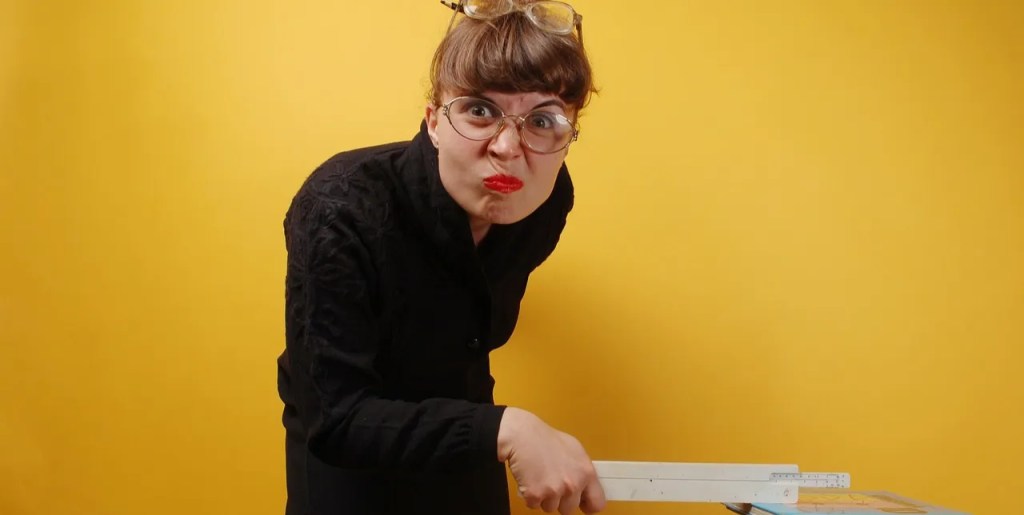
I kind of like to think I give off this sort of “Rebel without a cause” vibe and have a reputation as a rule breaker. I mean, I know how to ride a motorcycle, most of my jeans have holes in them, and I even own a leather jacket. I know right, hide the children. A few days ago, as I was leading a room full of kid’s ministry volunteers through our safety and security policies, I shared this picture of myself. I remember my exact words, “I’m not saying this because I’m a rule follower, I say it because it’s truly important.” Instantly I felt the look from one of my staff members. You know the look. It’s the look you give your kids at night when they tell you they already brushed their teeth. It’s the look you used to give your younger sibling when they told you to close your eyes for a surprise. It was the look that says, “Um… no.”
I was shocked that someone would give me that look. I mean, I own a leather jacket! But here I was face to face with the reality that I do enjoy rules, procedures, and dare I say it, policies. There is something about order and organization that makes me feel free. I could go off on a wild tangent here about the importance of structure and organization but that’s not what hit me in this moment. What hit me was the fact that I was shocked to learn that I was indeed a rule follower. I started asking myself all kinds of questions like, “Is this true?” “How long have I been this way?” “Why did I not know?” “Why has no one told me?” “Would my in-laws be shocked to hear this news?” I’m telling you; it was an eye-opening moment.
The truth is, we all have blind spots. We all have areas of our lives where we think something is true only to eventually find out that reality is in fact the opposite. The question we must answer is how will we respond to this news? We have a few options in these situations. We can disregard, we can double down, or we can do something with it.
Our first instinct is often to disregard. We love to avoid feedback and act like it never happened. If we didn’t hear it, it wasn’t said right? The problem with that is that by disregarding feedback, we get ourselves stuck. We stop growing, we stop learning, and we stop becoming more of the person we were created to be. Good news, I did not opt to employ this method.
Instead of disregarding, I doubled down. I returned her look with a look of my own. Mine was the look that said, “You don’t know me, and you certainly don’t know what you’re talking about.” The problem was that she does know me and, as much as I hate to admit it, she did know what she was talking about. I have become a bit of a rule follower these days. Doubling down only damages the relationship and makes people less likely to share your blind spots in the future. What I’m saying is, I do not recommend.
All that leaves is the final option, do something with it. Take the feedback and consider it. Ask yourself a few questions to help you discern what you need to do with this new information. Is it true? If not, ask yourself what actions are giving off that perception. Seek to amend these actions. If it is true, ask yourself “What do I need to change?” Then, set some goals and make those changes. I’m not saying that every piece of feedback we get in our lives requires major change, or even any change at all. The old adage goes, when someone gives you feedback, chew the meat and spit out the bones. Truly examine the feedback and do what you need to do with it.
For me, learning I was a rule follower didn’t require me to change but it was a challenge to lean further in to my authentic self, to be who I am. I simply needed to be ok with the fact that I find rules to be comforting. Truly, I nailed that one. But there have been times in my life that have required more work. I have learned that I can be single focused at times and in those moments, I can run people over with my excitement. I didn’t nail that one quite so handily. I had to work hard to curb this tendency and it’s still something I catch myself doing from time to time. We’ll never arrive, we’ll never be perfect. But we can be better, and we can grow. But to do this we need people who are willing to help up see our blind spots and we need the humility to acknowledge and address those blind spots as they come.
Who has permission to point out your blind spots? What changes do you need to make to grow past them?
 BrandonHair.me
Leave a comment